Gaby’s Tea Time Your Straight Back Might Be the Problem
Everyone worries about excessive spinal curves. But what happens when those curves disappear?
When people talk about poor posture, they usually worry about having too much curvature in their spine.
An excessive arch in the lower back. An anterior pelvic tilt. A rounded upper back. A hunched posture.
These are the things people notice in the mirror and try to correct.
So what do they do?
They tuck their pelvis, pull their shoulders back, lift their chest and try to make their spine straighter.
But here's something most people overlook.
What if your spine is already too flat?
And what if trying to straighten it further is making things worse?
Your spine was never designed to be straight.
Look at a human spine from the side.
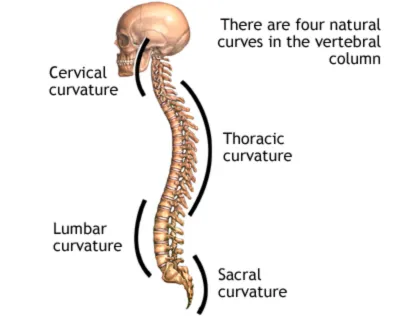
It has a natural double-S-shaped curvature.
Your cervical spine curves forwards.
Your thoracic spine curves backwards.
Your lumbar spine curves forwards.
And your sacrum curves backwards.
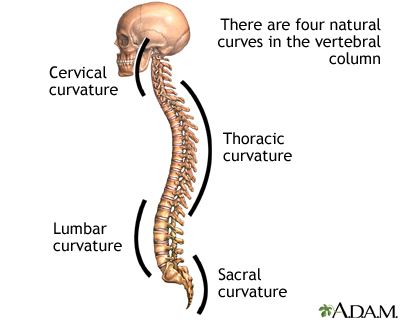
These curves are part of the structure that allows your body to remain upright against gravity, absorb and distribute forces, and adapt to movement.
Think about what happens when you walk, run or jump.
But what happens when those curves become flattened?
When the spine loses its natural curves, it may become less adaptable to impact and less efficient at distributing forces throughout the body.
As a result, certain muscles and joints may have to work harder to manage those forces.
Over time, this compensation strategy can become exhausting and restrictive.
In my coaching experience, people with flattened spinal curves tend to experience pain more frequently than those with exaggerated curves.
But more curvature isn't always better either.
Now consider the opposite situation.
Someone with a pronounced anterior pelvic tilt and an exaggerated arch in their lower back.
Their lower back may appear compressed into extension, while their rib cage moves forwards.
This is is just another strategy the body uses to stay upright.
Instead of relying primarily on rigidity, the body may rely on excessive extension in certain regions.
Both patterns can reflect different compensation strategies.
The problem isn't simply how much your spine curves. It's whether your body can use those curves effectively.
So what should good posture actually look like?
Like this:
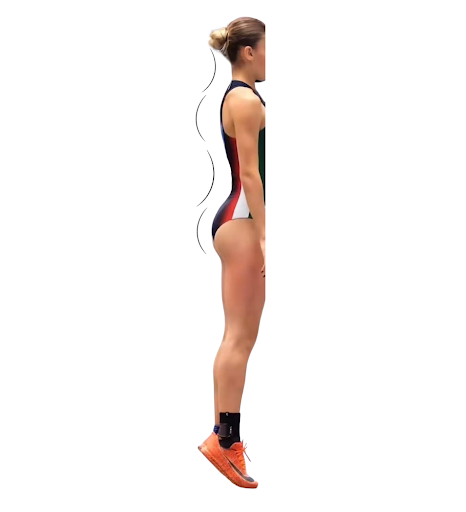
Notice how the body remains upright while maintaining the spine's natural curves.
However, in this example, the thoracic spine still appears slightly flattened, and the upper arms (humeri) sit slightly forwards relative to the torso.
This is an important reminder that alignment is not simply about looking straight.
It's about how your entire body supports itself against gravity.
Your spine doesn't work in isolation.
If you've spent years stretching your back, correcting your posture or strengthening individual muscles, only to find yourself dealing with the same stiffness or discomfort, perhaps it's time to look beyond your spine.
Your feet, pelvis, rib cage and spine all work together to keep you upright.
When that organisation changes, your body may develop compensatory strategies to maintain balance.
And simply forcing your spine into a different position may not address what's driving those compensations.
Human Before Athlete.


