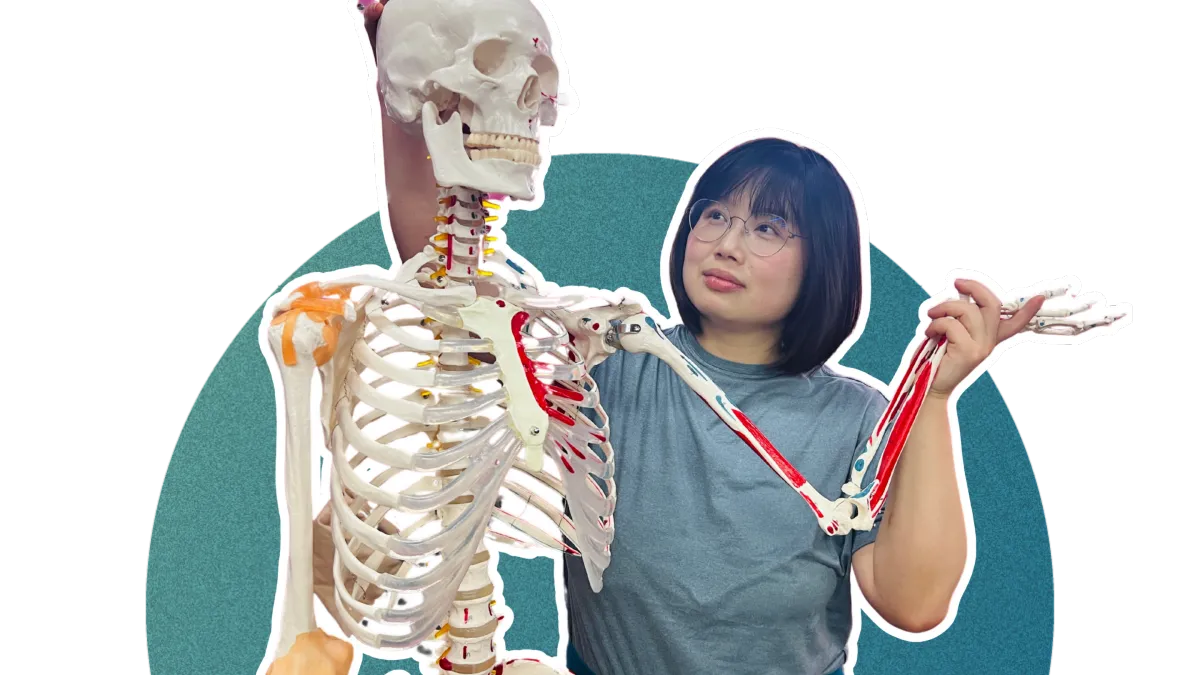
Gaby’s Tea Time - What Do I Want To Build With BAT?
People often ask me what I actually want to do with BAT.
The answer is simple.
I want to build a training method that increases the structural order of the human body, so we can slow down the entropy of aging.
Death is unavoidable.
But the quality of how we live before death, how we move, breathe, function, and remain independent, is something we can still influence.
The modern world is obsessed with removing pain as quickly as possible.
At the lighter level,
people use massage, stretching, foam rolling, or passive recovery methods.
Why do these methods feel good?
Because they can temporarily reduce tension, calm the nervous system, improve circulation, or change sensation.
But temporary relief does not mean structural change, that’s why the relief only lasts from a few hours to a few days, no more than two weeks.
Then we move into stronger interventions.
Painkillers.
Steroid injections.
Anaesthesia.
They begin cutting your perception itself.
Pain is a signal.
It warns you that the body perceives danger, prompting you to stop moving in a way that may cause further damage.
When you silence the signal, the pain may disappear — but the underlying problem often remains.
The body is still operating under the same stress; you have simply disconnected the warning system it relies on.
Then at the highest medical level,
we have stem cell therapy,
surgery,
or even full joint replacements.
These methods can repair tissue, delay degeneration, or replace damaged surfaces.
And again, some of these procedures are necessary.
I am not against medicine.
But these solutions do not reorganise the body into a better structure.
They do not restore breathing mechanics, balance, gait, rotation, muscular coordination, or structural alignment
(Yes, a knee replacement gives you a mechanically fixed trajectory at the knee joint.
But it does not resolve the compensatory strategy that created the problem in the first place. If the underlying movement pattern remains unchanged, the compensation simply relocates somewhere else in the system — usually the hip, pelvis, spine, or opposite leg.)
Most of the time, the body continues to move through the exact same compensatory patterns underneath.
You simply feel less pain — temporarily.
And over a long enough timeline, the pain usually comes back once the body runs out of compensation strategies.
That is the part people rarely think about.
Sometimes people trade long-term function for short-term comfort without even realising it.
I have seen this many times with women after pregnancy.
Pregnancy places huge compression and stress on the lower back and pelvis for months.
Then during or after childbirth, some women receive pain-management injections, steroids, anaesthesia, or other interventions.
The pain disappears.
But pain disappearing does not mean the body reorganised itself, the structure is still dysfunctional underneath.
The body simply loses the feeling temporarily and continues compensating around the problem.
Then life goes on.
Five years.
Ten years.
Twenty years.
The body keeps using other muscles, other joints, and other movement strategies to survive.
Until one day the compensation system runs out of options.
That is when the pain comes back.
And usually it comes back much worse.
Now the difficult part starts.
Because after years of compensation, the brain often loses proper control over the body.
The nervous system has spent too many years avoiding correct movement patterns.
So when people finally try to train again, rebuilding becomes extremely difficult.
Not because the pain suddenly appeared.
The problem was there the whole time.
The body was simply delaying the consequence.
And the longer the delay, the more expensive the consequence may become later.
The human body does not reorganise itself simply because something was done to it.
The human body adapts to force.
MECHANICAL PRESSURE SHAPES THE ORGANISATION OF THE BODY.
Bones adapt to load.
Muscles adapt to tension.
The nervous system adapts to repeated movement and coordination.
If you train under heavier load, bone density increases.
If you stop using certain movement patterns, the nervous system loses control over them.
The body is constantly adapting to the environment and the forces acting on it.
That adaptation is what shapes human structure.
Maybe BAT is not for everyone.
Because structural change requires effort.
And effort is a price not everyone is willing to pay.
Sometimes it also means facing the reality that the body has been compensating for years.
There are many things training cannot fully control — nutrition, sleep, stress, etc…
But structural change follows mechanical pressure.
If you want the body’s geometry to change, the body must physically adapt to force.
Which means training is unavoidable.
Because I do not just want people to temporarily feel less pain.
I want people to still have ownership over their body ten, twenty, or thirty years later.
To still move willingly.
To still breathe easily.
To still have control over their own structure — and therefore, their own life.
Because eventually, the body tells the truth.
And when that moment comes, I hope your body still remembers how to move.


