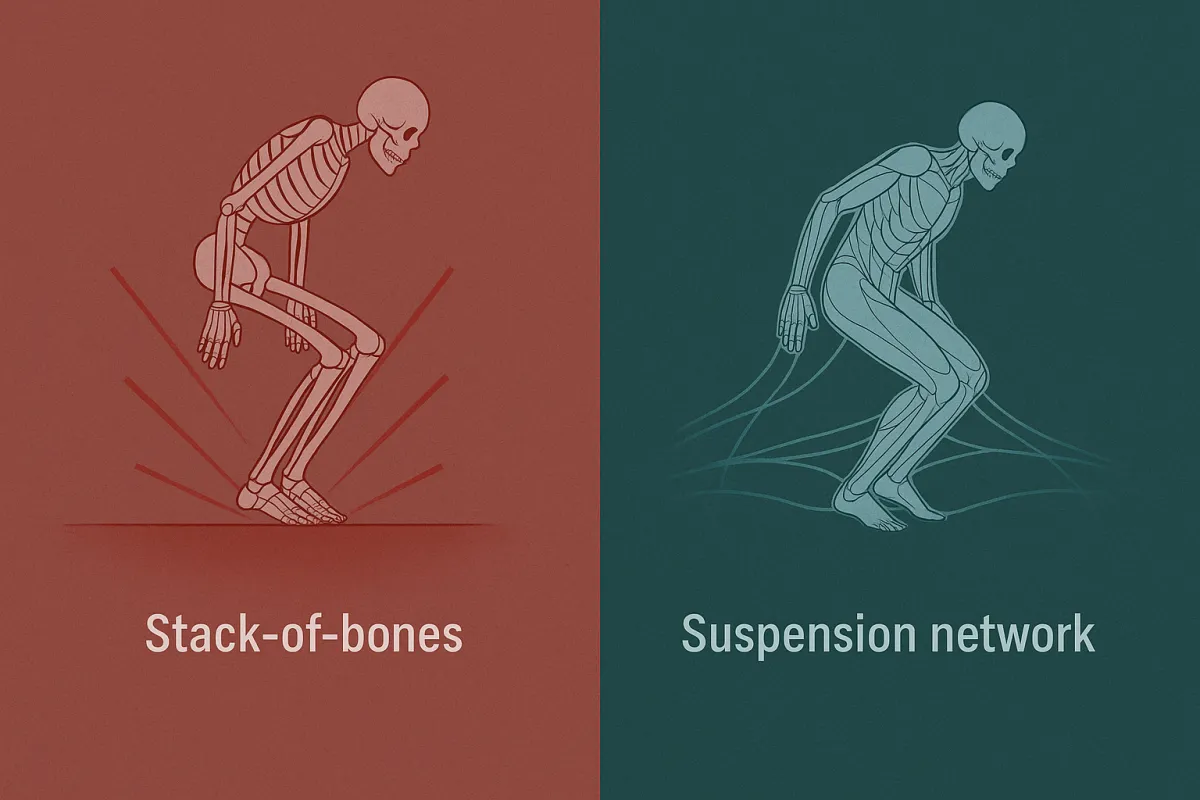
Gaby’s Tea Time - Movement Is Not a Set of Patterns, It Is a System of Constraints
Human movement is usually taught through a small catalogue: squat, hinge, push, pull, rotation.
This catalogue is treated as if it describes nature.
It does not.
It describes coaching convenience.
The first error is assuming these are “fundamental movements”.
They are not.
They are labels applied to different loading situations.
Once you remove the gym context, the categories stop holding together.
A “squat” is not a movement type.
It is a way of managing vertical load when the load is in front of or above the body.
A “deadlift” is not a different movement.
It is the same vertical load problem, but the load starts closer to the ground, changing leverage and increasing hip demand at the beginning.
Nothing fundamental changes in the body.
Only the starting conditions change.
So lower body classification collapses into one problem:
vertical force management under different load positions.
Everything else is variation inside that problem:
hip contribution increases or decreases
ankle strategy increases or decreases
(knee demand changes as a result of hip–ankle coordination)
spinal extensor demand shifts
The system is still solving the same task:
move and control vertical force through a linked chain.
Upper body classification fails in the same way.
“Push” and “pull” are not opposites.
They are the same system expressed in different force directions.
The system is always:
scapula + rib cage as the base
humerus as the lever
arm as the force transmitter between trunk and external load
Whether you call it push, pull, press, or row, the structure is identical.
Only the direction of force changes.
Horizontal and vertical variations (bench press, overhead press, pull-ups, rows) are not different movement families.
They are the same transmission system operating under different external constraints:
where the force enters the body
where the body is supported
how the scapula is allowed to move on the rib cage
So the real variable is not “push vs pull”.
It is how force is transmitted through the upper limb and trunk system under constraint.
This leads to a more accurate model:
The human body does not organise movement around “types of exercise”.
It organises movement around three simple conditions:
Where the load is placed
What is fixed and what is moving
How force enters and exits the body
Everything else is secondary adjustment.
From this perspective, traditional taxonomy is useful for beginners in the gym, but limited as an explanatory model.
It describes what movement looks like, not what the system is solving.
The implication is simple:
If a classification system cannot explain changes when:
load position changes
base of support changes
constraint conditions change
then it is not a movement model.
It is only naming.
A more fundamental approach removes exercise categories entirely.
It replaces them with constraint problems:
Vertical load management
→ coordinated hip–knee–ankle force distribution under gravity
Upper limb force transfer
→ scapula–rib cage system transmitting force through the arm
(and there are full-body movements and rotation, which we will discuss in another episode)
Exercises are not identities.
They are temporary solutions to constraint conditions.
So the coaching question changes.
Not:
“What exercise is this?”
But:
“What is the system solving under this constraint?”
That is the real unit of analysis.
Everything else is vocabulary.


